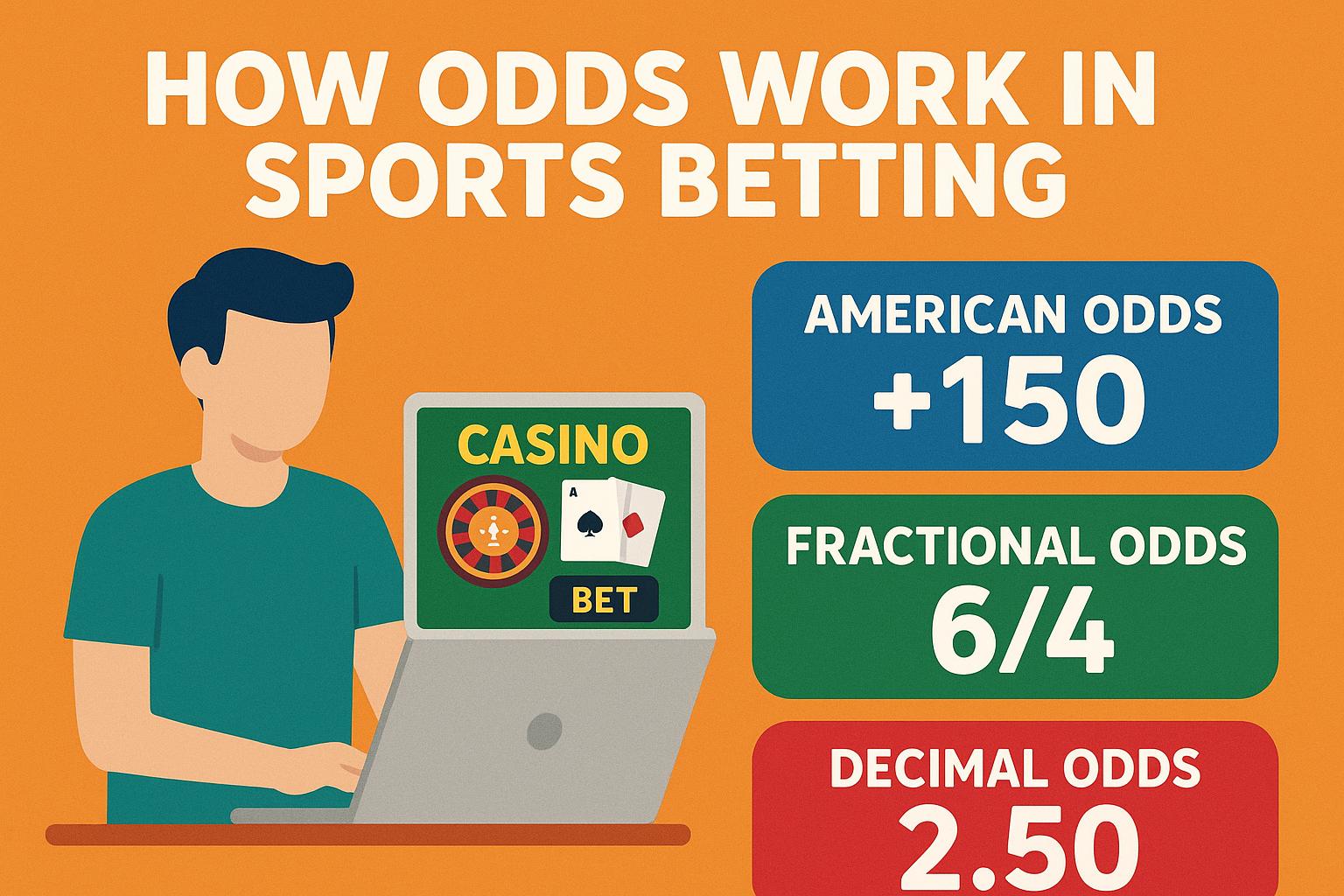
How do odds work in sports betting?
Understanding Sports Betting Odds
When entering the world of sports betting, one of the first things a bettor will encounter is betting odds. These odds are integral to placing wagers and understanding potential payouts. Sports betting odds can appear in various formats, and knowing how to interpret them is crucial for both novice and experienced bettors.
Types of Odds Formats
There are three primary types of odds formats used in sports betting: decimal odds, fractional odds, and moneyline odds. Each format represents the same concept but presents it differently.
Decimal Odds
Decimal odds are predominantly used in Europe, Australia, and Canada. They are straightforward and express the total payout a bettor will receive for a unit stake, including the original stake. For example, if the decimal odds are 2.50, a successful $10 bet would yield a $25 total return ($10 x 2.50). This transparency makes decimal odds popular among bettors as they allow them to quickly calculate potential returns without requiring complex mathematics or additional tools.
Decimal odds are calculated by simply multiplying the stake by the odds to determine the potential payout, including the original stake. They offer an intuitive way to compare various bets since the higher the decimal odds, the larger the potential payout for a successful bet relative to the stake. This format is especially beneficial for those new to betting, as it simplifies the process of understanding potential gains.
Fractional Odds
Fractional odds are commonly used in the UK and Ireland. This format presents the profit relative to the stake. For instance, odds of 5/1 would mean that for every $1 bet, the bettor will profit $5, plus the return of the initial stake, resulting in a total of $6. This format is popular among horse racing bets.
Fractional odds can be expressed as a simple fraction, representing the profit based on the stake. For instance, the fraction 5/2 indicates that for every $2 wagered, the bettor stands to win an additional $5. This tradition of using fractional odds has emerged from the rich history of betting in the UK and Ireland, particularly in horse racing, where these odds types originated.
While fractional odds may initially seem more complex than decimal odds, they offer experienced bettors clarity in understanding and assessing the risk-to-reward ratio in specific bets. Understanding how to interpret these odds can enrich your betting strategy, especially in regions where these types of odds are the standard.
Moneyline Odds
Moneyline odds, or American odds, are widely used in the United States. They appear with either a plus (+) or minus (-) sign. Positive moneyline odds indicate how much profit you will make on a $100 bet. For example, +200 means a $100 bet could win $200 in profit. Negative moneyline odds indicate how much you need to stake to win $100. For instance, -150 means you need to bet $150 to make a $100 profit.
Moneyline odds serve a dual purpose, not only denoting potential profits or required stakes but also indicating which team or participant is favored to win. In this format, a higher positive number suggests a lower likelihood of winning, while a negative figure highlights the favored side in a contest.
Moneyline odds are often used in sports like basketball and American football, where these odds provide a concise overview of expected outcomes. Mastery of moneyline odds provides clarity on payout structures and betting strategies, crucial for making informed decisions tailored to the American sports market.
Converting Odds
Understanding how to convert between odds formats can be helpful. While each format seems unique, they all represent the same probability of an event occurring. Many online calculators allow for quick conversions between decimal, fractional, and moneyline odds, providing more flexibility in analyzing potential bets.
Being able to fluently convert between these formats enhances a bettor’s capability to operate on global sportsbooks and compare odds offerings across different regions. Knowing conversion formulas is an essential skill for those who partake in international bets, opening the door to the richer strategic betting diversification.
Odds and Probability
Odds are not just about potential payouts; they also reflect the probability of an event occurring. The lower the odds, the higher the probability of the outcome. For example, odds of 1.50 (or 1/2 in fractional) suggest a high chance an event will happen, while odds of 5.00 (or 4/1 in fractional) suggest a lower chance.
Understanding the underlying probability associated with odds allows bettors to gauge the likelihood of an outcome, essential for constructing effective betting strategies. This involves not just considering the potential rewards but weighing them against real-world chances, a critical step towards successful betting.
Calculating Implied Probability
To determine the implied probability from odds, one can use simple formulas:
Decimal Odds: Implied Probability = 1 / Decimal Odds
Fractional Odds: Implied Probability = Denominator / (Denominator + Numerator)
Moneyline Odds: For positive odds, Implied Probability = 100 / (Odds + 100). For negative odds, Implied Probability = – (Odds) / (Odds – 100).
Understanding implied probability helps bettors gauge the bookmaker’s perspective and assess whether they believe an outcome is likely. This quantitative approach guides bettors in comparing their assessments to those of bookmakers, enabling them to find potential value in the odds where their judgment diverges from the bookmaker’s predictions.
Moreover, studying implied probabilities shifts the focus from mere payouts to broader strategic perspectives, where long-term success hinges not just on single wins but consistent prediction accuracy.
Summary
Interpreting sports betting odds is essential for effective betting. Each of the formats—decimal, fractional, and moneyline—has unique characteristics but ultimately serves the same purpose. By understanding these odds and their implications, bettors can make informed decisions, improving their ability to wager strategically. For further information on sports betting odds and strategies, explore dedicated resources or guides available online. By deepening their knowledge of betting odds and probabilities, bettors can better navigate both local and international betting markets.
Ultimately, the key to success in sports betting lies not solely in understanding odds but in developing a well-rounded strategy that incorporates risk management, thorough research, and awareness of one’s own strengths and limitations. With this comprehensive approach, the world of sports betting becomes not just a game of chance but an endeavor of calculated decision-making rooted in knowledge and insight.